
How Exposure Management Improves SOC Decision Making

PAGO Gartner Security & Risk Management Summit On Site Report
PAGO attended the 2026 Gartner Security & Risk Management Summit in National Harbor, Maryland, and sharing key insights from the security sessions discussed on site. This report examines Breaking Boundaries: Uniting Exposure Management and Threat Detection and Incident Response, presented by Pete Shoard. It explores why Exposure Management plays an important role in turning detection alerts into response decisions and how Exposure Management and Threat Detection, Investigation and Response (TDIR) can work together to improve security operations.
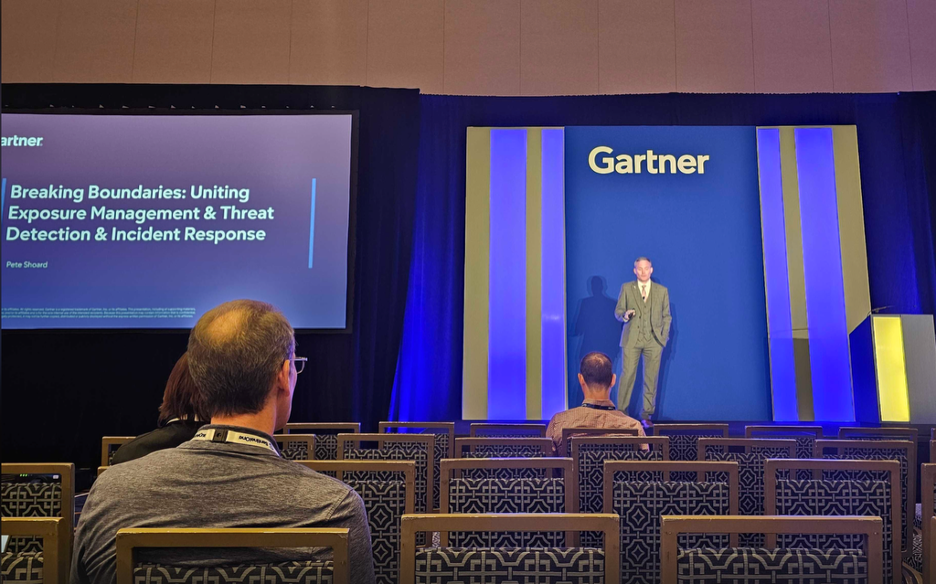
Sometimes the value of two things only becomes visible when they are brought together. Pete Shoard used the example of a peanut butter and jelly sandwich to explain the relationship between Exposure Management and TDIR (Threat Detection, Investigation and Response).
TDIR is responsible for detecting threat signals, investigating suspicious activity, and supporting response actions. When information about asset exposure, attack paths, vulnerabilities, configurations, and access privileges is added to that process, security teams gain a stronger foundation for deciding what should be investigated first and where action should be taken.
What Should Be Investigated First?
TDIR is one of the most important functions within security operations. Security teams have spent years improving their capabilities through technologies such as SIEM, XDR, and SOAR. Threat intelligence and AI capabilities are also becoming part of detection and investigation workflows.
The challenge highlighted by Pete Shoard was not a shortage of information. SOC teams already manage large volumes of alerts, events, logs, and threat intelligence. TDIR plays a critical role because it helps identify genuine threat activity and connect those findings to investigation and response. However, information alone does not always support prioritization.

When an alert is generated, security teams need more than an answer to whether the event is malicious. They also need to understand which asset is involved and how that asset is connected to exposures and attack paths.
The purpose of TDIR is to investigate detected threats and support response decisions. When exposure data, asset information, and attack path analysis are included in that process, security teams can make better decisions about response priorities.
When Detection and Exposure Are Connected, Real Risk Becomes Visible
Pete Shoard explained that for detection alerts to lead to meaningful response actions, the importance of the affected asset, its exposure status, and potential attack paths must all be considered together.
Exposure Management helps organizations understand their attack surface, vulnerabilities, configurations, assets, and attack paths. Its purpose is to determine whether an identified exposure could realistically contribute to an attack.
This perspective differs from traditional vulnerability management. The important question is whether an identified exposure could be used as part of a real attack path, which assets and business functions could be affected, and which actions would have the greatest impact on reducing risk. The attack surface and exposure data provided by Exposure Management offer valuable context. Operational priorities, however, require additional information.

Organizations also need to consider detection alerts, attack attempts, detection rules, and incident response data generated within the SOC. TDIR and Exposure Management each provide different forms of evidence that support security operations. TDIR identifies genuine threat activity through alerts and events. Exposure Management provides visibility into the exposure status and attack paths associated with affected assets.
When these perspectives are combined, security teams can make more informed decisions about the priority of detected activity.
Decision Making Improves When Different Insights Are Connected
The reason TDIR and Exposure Management need to work together is because attackers do not operate according to the boundaries security teams create between tools and data sources. Attackers do not view vulnerabilities, misconfigurations, exposed services, excessive privileges, and detection gaps as separate issues. They connect those elements into a path that can lead from initial access to lateral movement, privilege escalation, and access to sensitive data.
Security operations therefore cannot evaluate alerts and exposures independently. An abnormal activity alert associated with a particular account may appear important on its own. The response priority changes depending on whether that account can access externally exposed systems, whether it has administrative privileges over critical business systems, and whether it is connected to a validated attack path. Placing vulnerability data, configuration data, attack surface information, validation results, threat intelligence, alert data, and event data into a single repository does not automatically produce better decisions.
Security data comes from different sources, serves different purposes, and follows different structures. Even within the same organization, asset classifications, risk scores, and investigation priorities may differ.

The approach described by Pete Shoard is centered on connecting evidence across security disciplines. TDIR should incorporate exposure status, attack paths, validation findings, configuration risks, and access privilege information provided by Exposure Management.
Exposure Management should also make use of real detection alerts, recurring attack attempts, detection rules, and incident response data generated through TDIR activities. The objective is understanding how each dataset contributes to a decision and ensuring those decisions lead to action.
As security environments generate more information, success depends on whether that information helps teams determine what should be reviewed first and what decisions should follow.
Conclusion
The purpose of connecting TDIR and Exposure Management is not simply data integration. While TDIR focuses on detecting, investigating, and responding to active threat signals, Exposure Management provides the context needed to understand how those signals relate to assets, exposure conditions, and attack paths.
When these two areas are connected, security teams can interpret alerts as indicators of real risk rather than isolated events. Ultimately, what matters is the ability to connect alerts to response decisions. When TDIR and Exposure Management remain separated, security teams continue to face the same question: "What should we investigate and address first?"
From the perspective of an MDR service provider, the goal is to help organizations interpret detection activity in the context of asset exposure and attack paths, and use that information to determine response priorities. The combination of Exposure Management and TDIR is ultimately an operational challenge. It is about understanding detected activity within the context of real risk and making informed decisions about what should be investigated and addressed first.

Written by: Siwoo Lee Threat Analyst | DeepACT MDR Center


