Cybersecurity and Business Resilience in the Age of Dark AI

PAGO Gartner Security & Risk Management Summit On Site Report
PAGO is attending the 2026 Gartner Security & Risk Management Summit in National Harbor, Maryland, and publishing a series of reports covering the key security sessions discussed at the event. This first report explores how the rise of Dark AI is reshaping cybersecurity strategy, redefining the role of security leaders, and elevating business resilience as a core priority.

Executive Summary
The opening keynote at the 2026 Gartner SRM Summit presented the direction security leaders should take amid the growing concerns surrounding “Mythos” and the broader threat of Dark AI, which have recently become major topics across the cybersecurity industry. The core message was that even as modern AI technologies continue to weaken traditional defensive barriers, enterprise security teams can still respond from a position of strength through superior capital investment, environmental advantages, automation, and resilience.
McMullen also continued by saying, “Is Mythos genius, or simply genius marketing? That is probably the answer you want. In reality, it does not matter,” while repeatedly emphasizing the message that “AI is real.”
This report explores 5 major themes discussed during the keynote: the economic reasons defenders can still maintain an advantage against Dark AI, the use of AI driven engineering to fundamentally resolve accumulated technical challenges, strategies for managing increasingly complex AI ecosystems, the growing importance of Machine Identity management, and the shift beyond prevention toward business resilience.

Dark AI Threats and the Defender’s Advantage
The reality that attackers can now use AI to generate expert level attacks at scale, even at the level of script kiddies, is undeniably concerning. Gartner explained that if attackers can scale through automation, defenders can also scale their defensive systems through automation and potentially operate alongside or even ahead of attackers at enterprise scale.
Security cost efficiency: Compared to attackers who continuously burn massive numbers of tokens to launch attacks, defenders can operate far more efficiently by investing in automated scanning and patching.
Structural advantage: Security teams already understand their own internal enterprise environments, while AI has the ability to learn the unique operational flows of internal systems and detect abnormal behavior.


AI Driven Engineering and the Resolution of Accumulated Technical Challenges
McMullen defined AI not as “a tool that replaces marketing employees,” but as “a powerful weapon that can solve long standing enterprise technology challenges and help organizations build secure by design architectures.”
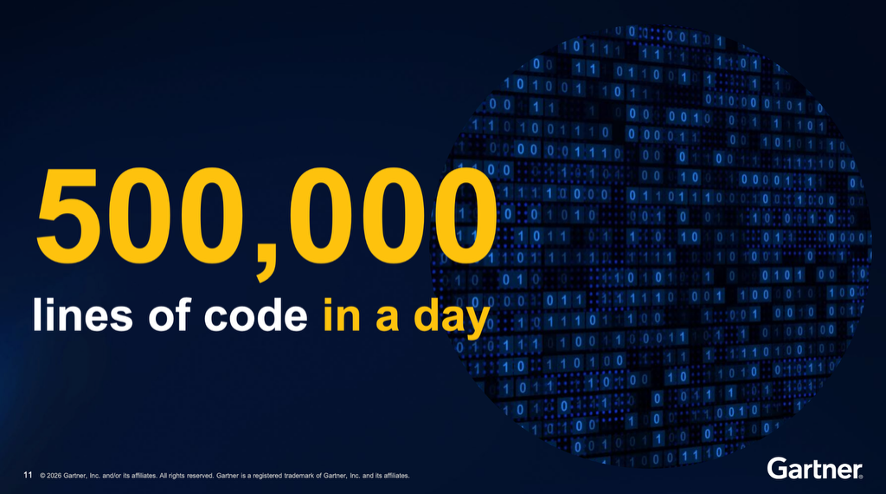
During this section, he referenced Claude Code and emphasized that “500,000 lines of code were ported in a single day across multiple languages and backends.” In practical terms, this suggests that tasks organizations have spent years asking developers to automate, such as vulnerability scanning and remediation, can now increasingly be executed through a single AI system prompt.

Managing the AI Agent Ecosystem Through the “Restaurant” Analogy
Future enterprise environments will consist of highly complex systems where countless AI agents continuously communicate with one another. McMullen compared this environment to the kitchen of a high end restaurant.
In a restaurant kitchen, the sauce chef and grill chef should each focus only on their own specialized responsibilities. McMullen explained that “if the grill chef is too slow and the saucier suddenly starts grilling premium steak directly, it becomes a major waste of resources.” In other words, AI agent ecosystems must also operate with strict separation of responsibilities.
Concept | Restaurant Analogy | Security and System Application |
Small Agents | Specialized chefs such as sauce chefs or grill chefs focused on a single task | AI agents with minimal privileges performing only narrow functions such as log collection or anomaly analysis |
Guardian Agent | Head chef responsible for monitoring the entire kitchen and intervening when issues occur | Monitors communication between agents and escalates activity when abnormal behavior is detected |

The Explosion of Machine Identities and IAM Modernization
McMullen explained that business email compromise often creates greater human driven financial damage than ransomware. He continued by emphasizing that strengthening these foundational areas is one of the most effective ways organizations can generate immediate security outcomes.
Inside enterprises today, there are approximately 80 times more Machine Identities than human identities. API keys, service accounts, bots, and system credentials are no longer optional areas of management. Continuous monitoring and governance of IAM through visibility and intelligence platforms will become one of the defining priorities of the coming era.

The Shift in the Defense Paradigm: Availability and Resilience
McMullen explained that in a market where cyberattacks have become normalized, the ultimate goal of cybersecurity is being redefined from “preventing every intrusion” to maintaining “business resilience.”
To support this shift, he stressed the importance of establishing clear Impact Thresholds that both executives and operational departments can align around.
For example, if a large retail company experiences more than three days of downtime in its procurement system, inventory shortages begin impacting physical stores.
As a result, organizations establish explicit business thresholds stating that regardless of the attack type, detection and recovery of the procurement system must be completed within three days.
Within this context, PAGO MDR’s Threat Containment service is designed to proactively suppress and interrupt threats within the customer’s defined business thresholds before incidents escalate into broader recovery situations.

Conclusion
The core message of Gartner’s 2026 opening keynote was that Security leaders do not need to become consumed by fear in response to the rise of Dark AI. As attackers continue evolving their tools, defenders are also gaining access to capabilities that were previously impossible.
McMullen explained that organizations now face a massive challenge in modernizing enterprises for Machine Identities and AI agents while confronting Dark AI. At the same time, he emphasized that this moment also represents “a tremendous opportunity to transform our mission into a winnable game centered on resilience and automation.” He concluded the session by encouraging organizations to begin with small, executable actions.
To support the business resilience principles emphasized during the 2026 Gartner SRM Summit opening keynote, PAGO delivers precise Threat Containment capabilities based on anomaly driven detection across customer environments. This serves as a practical approach that helps security leaders maintain operational control in rapidly changing environments.

Written by: Pyo Kwon CPTO | DeepACT MDR Center